ここから本文です
TWO:

Membrane separation type solvent dehydration system

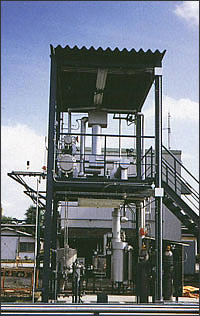
Great attention is recently being paid to global environmental issues, and it is now conceivable that companies will need to treat used solvents themselves. In consideration of this kind of social issue, we have developed a “membrane separation type solvent dehydration system,” which uses a polyimide membrane with superior dehydration properties developed by Ube Industries, Ltd. in combination with our own distillation and concentration technology that has resulted in solvents being more easily recovered.

THREE:On the third day Lord King moved that the Bill was not one of State necessity or expediency. This gave occasion to Lord Liverpool, then at the head of the Government, to express his sentiments upon the measure. He declared upon his honour and in his conscience that, if the Bill passed, he believed the king would not marry again. But if the charges against the queen were proved, it was absolutely impossible not to conclude with an enactment for a divorce. Earl Grey replied to Lord Liverpool, and called upon their lordships, from respect for their own character, not to persevere with the measure before them.The first great battle was destined to be fought on the very ground where Gustavus Adolphus fell, 1632. Buonaparte marched upon Leipsic, expecting to find the Allies posted there; but he was suddenly brought to a stand by them at Lützen. The Allies, who were on the left bank of the Elster, crossed to the right, and impetuously attacked the French, whose centre was at the village of Kaya, under the command of Ney, supported by the Imperial Guard, and their fine artillery drawn up in front of the town of Lützen; the right wing, commanded by Marmont, extending as far as the defile of Poserna, and the left stretching from Kaya to the Elster. Napoleon did not expect to have met the Allies on that side of Leipsic, and was pressing briskly forward when the attack commenced. Ney was first stopped at Gross-G?rschen. Had Wittgenstein made a decided charge with his whole column, instead of attacking by small brigades, he would assuredly have broken the French lines. But Buonaparte rode up, and galloped from place to place to throw fresh troops on the point of attack, and to wheel up both of his wings so as to enclose, if possible, both flanks of the Allies. The conflict lasted some[65] hours, during which it was uncertain whether the Allies would break the centre of the French, or the French would be able to outflank the Allies. Blucher was late on the field; the officer who was sent overnight to him with orders from Wittgenstein is said to have put them under his pillow and slept on them till roused by the cannon. At length, after a desperate attack by Napoleon to recover the village of Kaya, out of which he had been driven, the Allies observing that the firing of Macdonald and Bertrand, who commanded the two wings, was fast extending along their flanks, skilfully extricated themselves from the combat, and led back their columns so as to escape being outflanked by the French. Yet they did not even then give up the struggle for the day. The Allied cavalry made a general attack in the dark, but it failed from the mighty masses of the French on which they had to act. The Allies captured some cannon, the French none. The loss of the Allies was twenty thousand men, killed and wounded: that of the French was equally severe. Seven or eight French generals were killed or wounded. On the side of the Allies fell General Scharnhorstan irreparable loss, for no man had done more to organise the Prussian landwehr and volunteers. The Prince Leopold of Hesse-Homburg and the Prince of Mecklenburg-Strelitz, both allied to the royal family of England, were slain, and Blucher himself was wounded; but he had his wounds dressed on the field, and would not quit it till the last moment.
  • 1Under the distillation system, even in case of azeotropic solvent compositions, this system which remove water vapor by the polyimide membrane will easily dehydrate.
  • 2In comparison with the distillation system, it significantly saves on use of steam.
  • 3Dehydration can be performed through merely supplying evaporated vapor to the membrane module and maintaining the differential pressure between the permeable side and the impermeable side.
  • 4Solvent purity of 99.9% or more can be achieved by carrying out dehydration with a polyimide membrane only.
  • 5The polyimide membrane has superior heat and solvent resistance. Therefore, the vapor permeation system reduces contamination of the membrane and thus extends its life.
THREE:The introduction of the steam-engine, railroads, and canals enabled the coal-miners during this reign to extend the supply of coals enormously. In 1792 the coal-mines of Durham and Northumberland alone maintained twenty-six thousand two hundred and fifty persons, and employed a capital of three million one hundred and thirty thousand poundsa very small amount of both people and money as compared with the workers and capital engaged in the trade since the expansion of the manufacturing and steam systems. The coal-fields of Durham and Northumberland extend to nearly eight hundred square miles, but the beds in Northumberland, Durham, Yorkshire, the Midland Counties, South of Scotland, and Ireland, are still immense and not yet fully explored. Fresh strata are discovered as steam power enables us to go deeper. In 1817 Sir Humphry Davy perfected his safety-lamp, which, by means of a simple wire gauze, enabled the miner to work amid the most explosive gases. These lamps, however, were not able to protect the colliers from their own carelessness, and most horrible destruction, from time to time, took place amongst them from neglect.

The aromatic polyimide membrane is highly permeable to water vapor but less permeable to vapors of organic compounds such as alcohol etc.

THREE:The Duke had little to console him in connection with the general election. In passing the Emancipation Act he had made great sacrifices, and had converted many of his most devoted friends into bitter enemies. The least that he could expect was that the great boon which it cost him so much to procure for the Roman Catholics of Ireland would have brought him some return of gratitude and some amount of political support in that country. But hitherto the Emancipation Act had failed in tranquillising the country. On the contrary, its distracted state pointed the arguments of the Tories on the hustings during the Irish elections. O'Connell, instead of returning to the quiet pursuit of his profession, was agitating for Repeal of the union, and reviling the British Government as bitterly as ever. He got up new associations with different names as fast as the Lord-Lieutenant could proclaim them, and he appealed to the example of the French and Belgian revolutions as encouraging Ireland to agitate for national independence. In consequence of his agitation many Ministerial seats in Ireland were transferred to the most violent of his followers. During these conflicts with the Government Mr. O'Connell was challenged by Sir Henry Hardinge, in consequence of offensive language used by him about that gentleman, who was then Chief Secretary for Ireland. Mr. O'Connell declined the combat, on the ground that he had a "vow registered in heaven" never again to fight a duel, in consequence of his having shot Mr. D'Esterre. This "affair of honour" drew upon him from some quarters very severe censure.THE CHASE AT ARGAUM. (See p. 493.)
  • 1 Recovery of the detergent solvent Recovery of the cleaning solvent such as electronic parts industry, precision instrument industry.
  • 2Solvent recovery and the refinement Solvent recovery and the refinement such as chemical industry, an industry of medical supplies, food industry, the fermentation industry.
THREE:[573]By the terms of the Treaty of Tilsit, Prussian Poland was taken away, but not to be incorporated with a restored Poland, as Buonaparte had delusively allowed the Poles to hope. No; a restored Poland was incompatible with a treaty of peace with Russia, or the continuance of it with Austria. It was handed over to the Duke of Saxony, now elevated to the title of the King of Saxony and Duke of the Grand Duchy of Warsawthe name which Prussian Poland assumed. The duped Polish patriots cursed Buonaparte bitterly in secret. Alexander, with all his assumed sympathy for his fallen cousins of Prussia, came in for a slice of the spoil, nominally to cover the expenses of the war. Dantzic, with a certain surrounding district, was recognised as a free city, under the protection of Prussia and Saxony; but Buonaparte took care to stipulate for the retention of a garrison there till the conclusion of a general peace, so as to stop out any British armament or influence. To oblige the Emperor of Russia, he allowed the Dukes of Saxe-Coburg, Oldenburg, Mecklenburg-Schwerin, who were the Czar's relations, to retain possession of their territories; but he returned to Prussia only about one-half of the provinces which he had seized, reducing her very much to the limits in which Frederick the Great had found her before his usurpations. She surrendered her provinces between the Rhine and the Elbe, which, together with Hesse, Brunswick, and part of Hanover, were formed into the kingdom of Westphalia and given to Jerome Buonaparte. She was saddled by a crushing war indemnity, and had to leave Berlin and the chief fortresses in the hands of the French until the debt was paid. In the articles of the Treaty which were made public, Alexander paid a nominal courtesy to his ally, Great Britain, by offering to mediate between her and France, if the offer were accepted within a month; but amongst the secret articles of the Treaty was one binding the Czar to shut his ports against all British vessels, if this offer were rejected. This was a sacrifice demanded of Alexander, as Great Britain was Russia's best customer, taking nearly all her raw or exported produce. In return for this, and for Alexander's connivance at, or assistance in, Buonaparte's intention of seizing on Spain and Portugal, for the taking of Malta and Gibraltar, and the expulsion of the British from the Mediterranean, Alexander was to invade and[546] annex Finland, the territory of Sweden, and, giving up his designs on Moldavia and Wallachia, for which he was now waging an unprovoked war, he was to be allowed to conquer the rest of Turkey, the ally of Napoleon, and establish himself in the long-coveted Constantinople. Thus these two august robbers shared kingdoms at their own sweet will and pleasure. Turkey and Finland they regarded as properly Russian provinces, and Spain, Portugal, Malta, Gibraltar, and, eventually, Britain, as provinces of France.

Acetone, ethanol, methyl ethyl ketone, butanol, isopropyl alcohol, ethyl acetate, methyl isobutyl ketone, others (including hexane and toluene).